
Tim’s Latest Publication in BDJ Team discusses variability in periodontal inflammation

When plaque doesn’t explain the clinical picture: understanding variability in periodontal inflammation
Abstract
Variability in periodontal disease is a common feature of clinical practice. Patients with similar plaque levels can present with markedly different inflammatory responses and treatment outcomes. While plaque remains essential for disease initiation, it does not fully explain this variability. This article offers a practical framework to support clinical interpretation, considering host response, systemic influences, and dietary factors. The aim is not to change clinical protocols, but to support more nuanced understanding and patient communication in everyday practice.
Clinical relevance
Understanding factors beyond plaque may help clinicians better interpret variable periodontal responses and support more effective patient communication.
Objectives
To provide a practical framework for interpreting variability in periodontal inflammation in everyday clinical practice.
Main article
A familiar clinical scenario
Patients with similar levels of plaque often present very differently.
One patient attends irregularly, presents with visible plaque, yet shows minimal gingival inflammation and no clear progression over time. Discussions around oral hygiene are brief, and little appears to change between visits.
Another attends regularly, demonstrates good plaque control, and engages with advice, yet returns with persistent bleeding, localised inflammation, or early signs of periodontal breakdown. Each visit raises similar questions, often accompanied by a sense that something is being missed.
These patterns are familiar in clinical practice. They are not unusual, nor are they confined to specific patient groups. Over time, they become part of the background of everyday care. This is something many clinicians recognise, even if it is rarely articulated explicitly.
Plaque explains initiation, but not variability
The central role of plaque in periodontal disease is well established and remains the foundation of prevention and care. ¹,²
Without microbial biofilm, gingival inflammation does not occur. This understanding has allowed for the development of effective preventive strategies, reproducible indices, and consistent treatment protocols.
However, plaque does not fully determine disease trajectory. ³
Many patients with significant plaque accumulation do not progress to periodontitis, while others experience persistent inflammation or breakdown despite relatively good plaque control. Even where oral hygiene improves, inflammatory response does not always follow in a predictable way.
This creates a gap between what is expected and what is observed.
From a clinical perspective, the question is not whether plaque matters, but what determines how periodontal tissues respond to it?
Looking beyond the biofilm
Periodontal tissues do not respond in isolation.
The inflammatory response to plaque is shaped by a wider biological and clinical context, including host immune response, systemic health and metabolic status. ⁴,⁵
This is not a new idea. Associations between periodontal disease and systemic conditions such as diabetes are well documented, and the concept of inflammation as a systemic process is widely accepted.
However, in everyday clinical practice, these influences are not always integrated into how variability is interpreted. They are often acknowledged but remain peripheral to the core explanation of disease behaviour.
As a result, when outcomes do not align with expectations, the explanation can default back to plaque alone, even when that explanation feels incomplete.
Well-established associations between periodontal disease and systemic conditions such as diabetes and cardiovascular disease further support this broader perspective. In these contexts, periodontal inflammation is not viewed in isolation, but as part of a wider inflammatory and metabolic environment. These relationships are widely recognised in both research and clinical practice, yet they are not always fully integrated into everyday clinical interpretation of variability.5
The role of diet and systemic context
One area where this becomes particularly relevant is diet.
While diet is central to dental caries, its role in periodontal disease is often framed more generally, as part of broader lifestyle advice.6 However, increasing evidence links dietary patterns, particularly high intake of sugar and ultra-processed foods, with systemic inflammation and metabolic dysregulation.7,8
Ultra-processed foods are now a routine part of many diets. They are often energy-dense, high in refined carbohydrates and sugars, and low in micronutrient content. These characteristics are associated with inflammatory processes that extend beyond the oral cavity.
From a clinical perspective, this suggests that diet may influence not the presence of plaque, but the way the host responds to it.
In many cases, these influences are not immediately visible within the clinical setting. They sit outside the mouth, within everyday routines, shaped by convenience, environment, habits, social context and availability. This makes them easy to overlook, yet potentially significant in shaping inflammatory response over time.
Viewed in this way, sugar and ultra-processed foods do not act as alternative causes of periodontal disease, but as contextual factors that may help explain differences in susceptibility and response.
A clinical framework for interpreting variability
One way to bring these influences together is to consider periodontal inflammation as emerging from the interaction of several domains, as illustrated in Figure 1:
- plaque (trigger)
- host response
- systemic and dietary context
- time
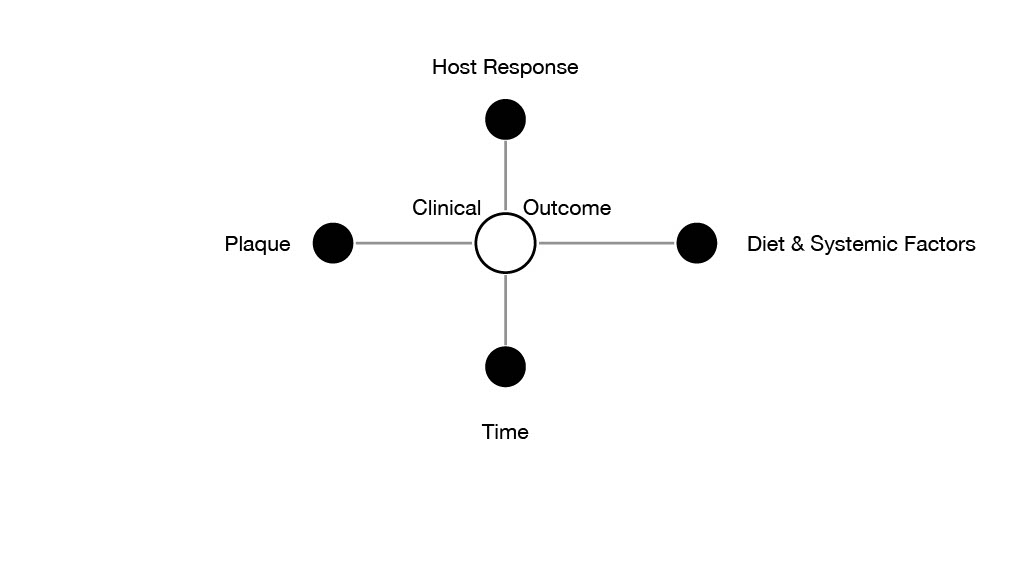
Figure 1. A clinical framework for interpreting periodontal variability (Ives, 2026). Plaque initiates inflammation, but host response, systemic and dietary context and time shape whether it resolves or persists.
This is not a model to apply, but a way of seeing what may already be present.
This framework is not intended as a mechanistic model, but as a simple way of organising clinical observation.
It reflects the idea that periodontal outcomes are not determined by a single factor, but by the interaction between multiple influences over time.
In some patients, these influences align in a way that supports resolution. In others, they may reinforce ongoing inflammation or increase susceptibility to breakdown.
Interpreting variability in practice
This perspective does not change clinical protocols. Plaque control remains central to prevention and care.
However, it may change how clinicians interpret what they see.
In practice, variability often appears in subtle ways:
• inflammation that seems disproportionate to plaque levels
• inconsistent response to otherwise appropriate care
• patients who engage with advice but show limited clinical improvement
In these situations, it may be helpful to consider whether factors beyond the local environment are influencing inflammatory response.
This does not require detailed investigation or diagnosis. Rather, it involves recognising that the clinical picture may reflect a broader context.
For example, gentle exploration of dietary patterns, general health, or lifestyle routines may provide additional insight. Even brief conversations can help patients connect oral health with wider aspects of their wellbeing.
This can be particularly relevant in patients where repeated reinforcement of oral hygiene advice has not led to the expected clinical improvement. This approach shifts the focus from identifying a single cause to recognising patterns.
A broader view of behaviour
This perspective also changes how behaviour is understood.
Less as something to be addressed in isolation, and more as something that develops within a wider system of influences.
Dietary habits, for example, are rarely the result of individual choice alone. They are shaped by availability, routine, social context and environment. The same applies to many health-related behaviours.
Recognising this does not remove responsibility, but it changes the way conversations are framed.
Instead of focusing solely on specific actions, clinicians can support patients in reflecting on patterns and context. This can open up more constructive and less repetitive discussions, particularly where previous approaches have had limited impact.
A small shift, but a meaningful one
When a model works well, it tends to be applied broadly.
The plaque-centred model has been highly successful, and it continues to underpin effective care. However, its success can also make it difficult to recognise where it may not fully explain what is being observed.
Acknowledging this does not require abandoning the model. Rather, it involves recognising its boundaries and considering how additional factors may influence outcomes.
This is a small shift in perspective, but it can have a meaningful impact on how variability is interpreted in practice.
Conclusion
Plaque remains fundamental to periodontal disease. However, variability in disease expression suggests that plaque alone does not fully explain clinical outcomes.
By considering the role of host response, systemic context and dietary influences, clinicians may gain a more complete understanding of periodontal inflammation.
This broader perspective does not replace existing approaches, but complements them, supporting more nuanced interpretation, more effective communication, and more personalised care.
References
1. Pihlstrom BL, Michalowicz BS, Johnson NW. Periodontal diseases. Lancet 2005;366:1809–1820.
2. Löe H, Theilade E, Jensen SB. Experimental gingivitis in man. J Periodontol 1965;36:177–187.
3. Baelum V, López R. Periodontal disease epidemiology—learned and unlearned? Periodontol 2000 2013;62:37–58.
4. Van Dyke TE, Serhan CN. Resolution of inflammation: a new paradigm for the pathogenesis of periodontal diseases. J Dent Res 2003;82:82–90.
5. D’Aiuto F, Parkar M, Nibali L, et al. Periodontal infections cause changes in traditional and novel cardiovascular risk factors: results from a randomized controlled clinical trial. J Dent Res 2006;85(7):678–683.
6. Moynihan P. Dietary advice in dental practice. Br Dent J 2002;193:563–568.
7. Hujoel PP, Lingström P. Nutrition, dental caries and periodontal disease. J Clin Periodontol 2017;44(Suppl 18):S79–S84.
8. Monteiro CA, Cannon G, Levy RB, et al. Ultra-processed foods. Public Health Nutr 2019;22:936–941.
This paper first appeared in BDJ Team June 2026